
Research Note 07
EPSON robot integration — RC+ plug-in
A plug-in that reduces RC+'s complex TCP/IP communication to a single line: Call AIVEManual(mm,hz,sec).
- EPSON RC90
- RC+ SPEL+
- TCP/IP Port 201
- Call AIVEManual()
- 4-unit simultaneous feeding
- AIVE base protocol
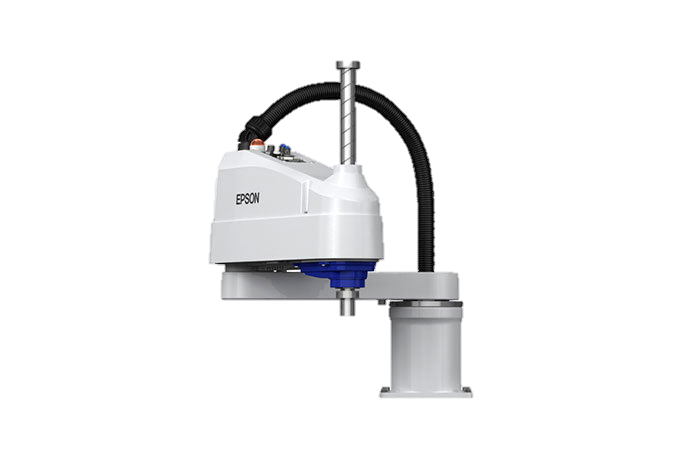
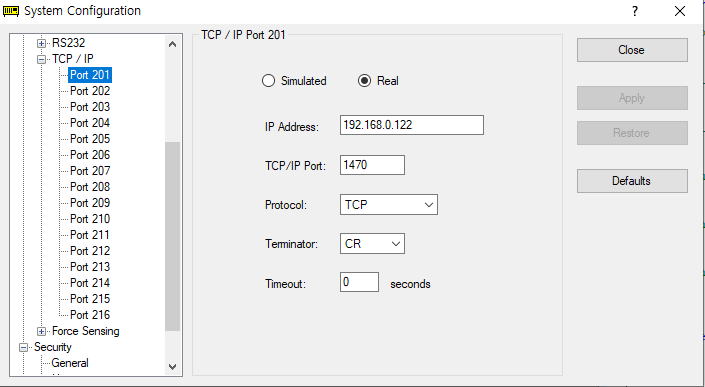
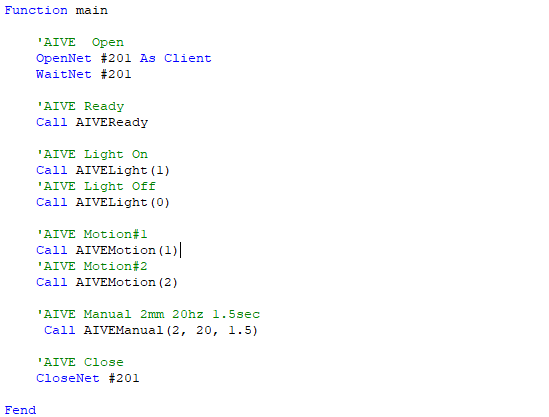
The EPSON RC90 controller sets the TCP/IP port directly in System Configuration. AIVE's IP (192.168.0.122) and port 1470 are registered on Port 201, with Protocol TCP and Terminator CR.
Before the plug-in, basic communication required sending the stroke first with Print #208, sending frequency and time separately, then managing the delay manually with Wait. The plug-in abstracts that whole sequence into a single Call AIVEManual(mm, hz, sec).
Provided commands: AIVEReady (motor ON + home), AIVELight(1/0) (lighting), AIVEMotion(1/2) (stored motion), AIVEManual(mm,hz,sec) (direct vibration). The AIVE base protocol (<C1> motor ON, <P1NNN> stroke, <P2NN,NN> frequency/time) is wrapped in RC+ functions.
The plug-in was distributed free to sites using EPSON RC+ with AIVE. The goal was that robot engineers shouldn't have to handle TCP/IP sequences directly. A setup connecting four AIVE SCARA units to feed four terminal types simultaneously was also verified on this plug-in.
This technology is inside our products today
The structures validated in research notes are now part of AimFactoryCore and Robot Suite.