
About AIM
Technology should
come to people
The robots are here. The cameras are here.
So why is automation still this hard?
OUR ORIGIN
Why we started


Problem
The robot was there. The vision was there.
They just weren't speaking the same language.
Robot, vision, and feeder each ran on different logic — so automation was slow, often stalled, and leaned on one or two skilled people.
Beginning
In 2016, AIM set out to solve this.
Instead of building one more machine, we set out to
make robots and vision speak the same language.
That's the software we've spent our time building since.
WHAT WE BELIEVE
What we believe
Technology should come to people
Until now, automation asked people to adapt to the machine. Learn the robot's language, keep a specialist on hand, reconfigure from scratch whenever the product changed.
We want to flip that. Usable without a specialist, with the hard parts handled by software, so the people on the floor have it easier. That's what it means for technology to come to people.
Robots and vision should work as one
Connecting a robot to vision was always a one-off — solved again at every site, re-solved whenever the engineer changed.
We treat it not as something to re-solve each time, but as one problem to solve properly, once. So a different brand or a different part still works the same way. Solving that properly is what AIM has been doing.
Not breaking on the floor comes first
For equipment, one more feature matters less than coming back up the next morning exactly as it was after an overnight power cut. A recipe that quietly disappears, an operator re-teaching everything from scratch without knowing why — that is where the most expensive hours on a production floor are lost.
So we spend our time where the screen doesn't show it. Saves that survive being interrupted halfway, failures that leave their cause in the log, software that still runs on an old shop-floor PC. It's the part nobody notices, but we believe that is where trust is built.
PROOF
Running on real production floors
Software built in Korea now runs on production floors in eight countries. The Ministry of Trade, Industry and Energy and the wider industry recognized the work along the way.
Built in Korea. Running worldwide.

- 2020
MOTIE Minister's Commendation
Roboworld — contribution to the machinery & robotics industry: e-cigarette, automotive-parts, and implant lines built
- 2016
Korea Quality & Innovative Awards
Hosted by Hankook Ilbo · Korea Quality & Innovative Awards
- 2016
Patent No. 10-1675863
Parts Feeder Assembly — registered Nov 2016
WHERE WE'RE GOING
The moment a robot sees, decides, and picks,
that's AIM's software at work.
We don't make automation equipment. We build the software that lets industrial robots see the world and move within it.
As Physical AI grows, so does the reason for technology to come closer to people.
MILESTONES
How we got here
AIM founded
Established through Korea's Young Entrepreneur Academy. Robot vision integration research begins.
FlexiBowl distribution starts
Italian FlexiBowl introduced to the Korean market. First deployment in mixed-model automation.
AIVE launched
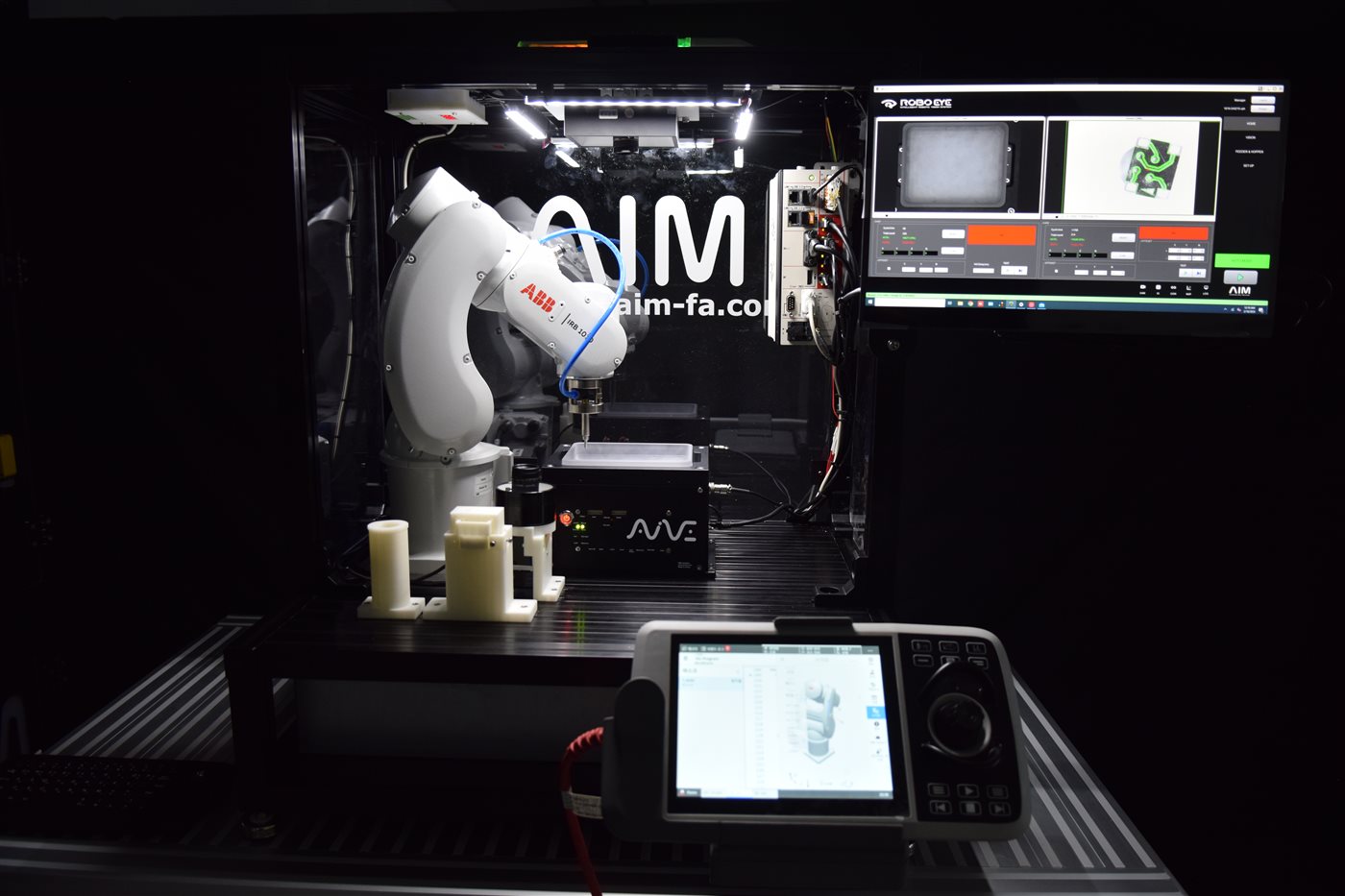
AIM's proprietary flexible feeder AIVE released. First mass-production deployment in Korea.
RoboEYE launched
RoboEYE robot vision released — a vision system that communicates directly with robots.
AimFactoryCore released
AimFactoryCore released — robot, vision, and feeder handled in one software.
Direct robot operation expands
Hyundai Robotics and Agilebot operated directly from the software. Multi-pick transfer from a single capture and automatic tool-calibration output applied.
START
Have a problem worth solving together?
Tell us about your robot, parts, and floor conditions, and we'll look at the right setup with you. The vision software is available on its own, too.