Case Study · Electronic component manufacturing

0.3 mm SMD Parts, Reel Taping Automated with ±0.05 mm Pick-and-Insert Error

0.3 mm-class SMD parts corrected by two cameras (top and bottom) were reel-taped automatically with a pick-and-insert error of ±0.05 mm, cutting work time by 70% compared with the manual process.

Pick-and-insert coordinate error Achieved by combining top- and bottom-camera correction data
±0.05 mm
Work time reduction Compared with the same process done by hand
70%
Multi-variant recipe changeover Over 20 part geometries on this line
Under 5 min
Reel taping defect rate Reel taping process on this line
0.001% or less

Micro SMD Reel Taping Automation with an IAI Robot, AIVE and RoboEYE

Watch on YouTube →

What and how

Configuration of this case

Part
Micro SMD parts (lead-frame and chip-type devices), over 20 types
Size
0.3 mm class
Process
Feeding → vision recognition → pick → reel slot insertion → taping inspection
Robot
IAI precision robot (X·Y·R coordinate link)
Feeder · Vision
AIVE 2.1 flexible feeder + RoboEYE dual-camera vision (top Cam1 / bottom Cam2)
Industry
Electronic component manufacturing
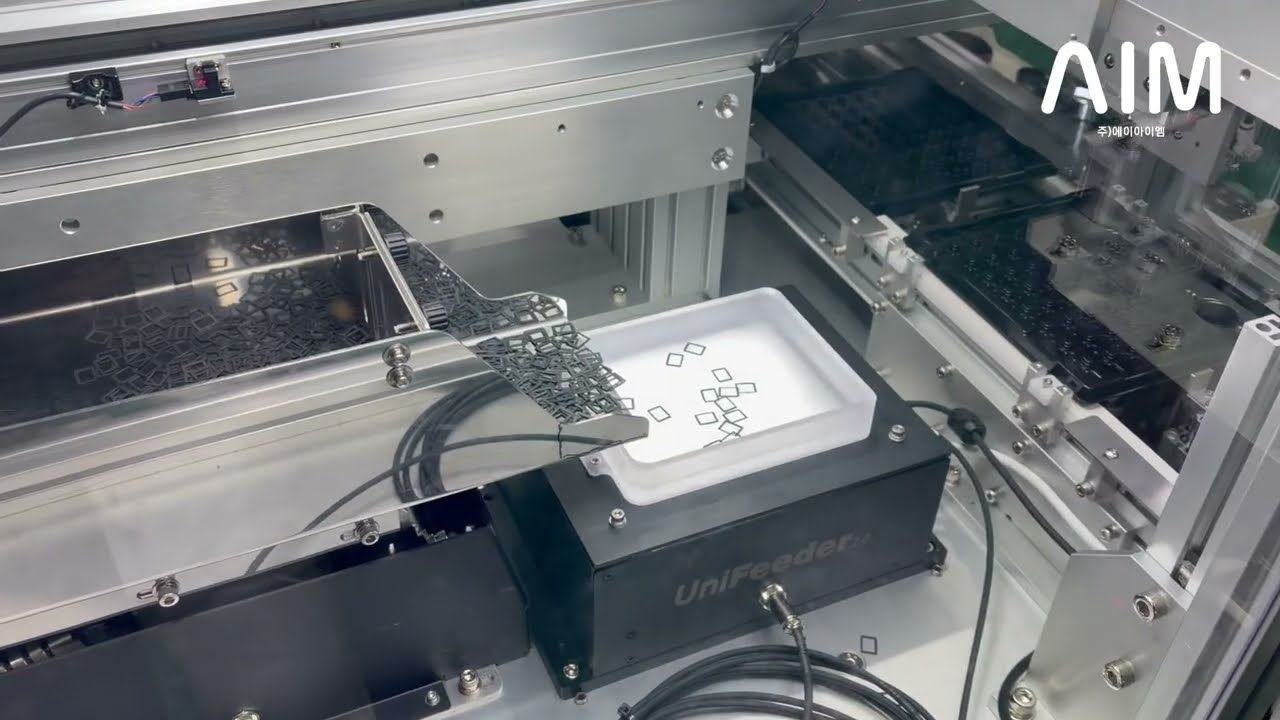
0.3 mm SMD Parts, Reel Taping Automated with ±0.05 mm Pick-and-Insert Error — part and detection view

Challenge

0.3 mm-class SMD parts were being picked up by hand and placed into reels

Precision assembly of 0.3 mm-class micro SMD parts such as lead-frame and chip-type devices was being done manually. Automating it required three things at once: aligning parts of 0.3 mm or less automatically and placing them into reel slots, accepting over 20 part geometries on the same equipment, and inspecting the reel taping result and keeping data without human intervention.

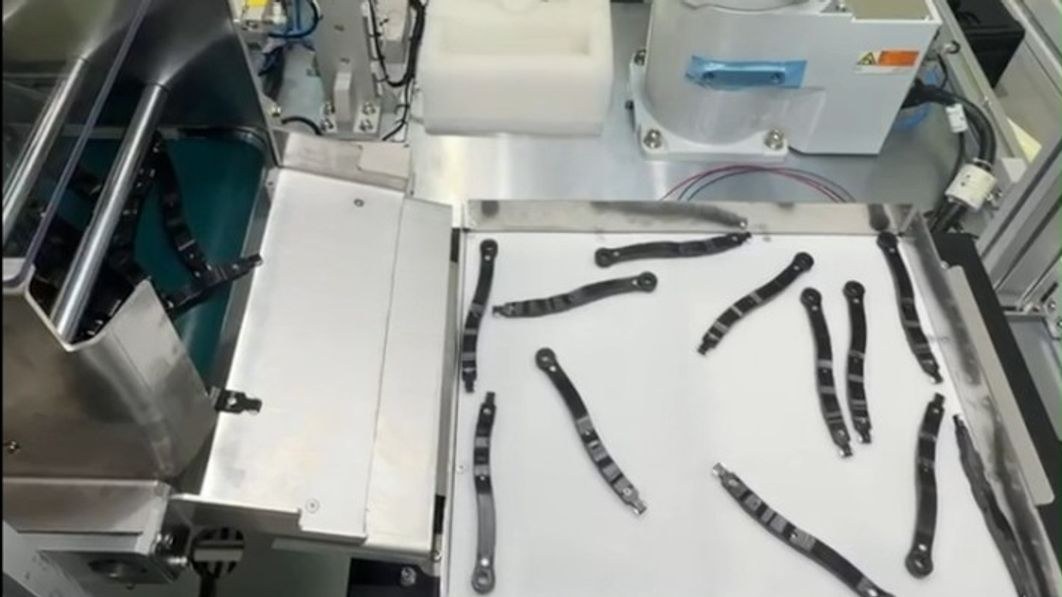
Overall configuration of the SMD reel taping system

Solution

Two cameras split the job: position before the pick, skew after the pick

The AIVE 2.1 flexible feeder scatters and feeds the parts, and the two cameras of RoboEYE dual-camera vision divide the roles to generate coordinates. The resulting coordinates are linked in real time with the X·Y·R data of the IAI precision robot, carrying the flow from pick to reel slot insertion.

  • The top camera (Cam1) recognizes the position, orientation and front-face geometry of the fed part.
  • The bottom camera (Cam2) checks and corrects the slight skew of 0.03 mm or less that occurs after picking.
  • Combining the correction data from both cameras secured an insertion coordinate accuracy of ±0.05 mm.
  • The feeder’s top vibrating basket structure applies vibration evenly to fine parts, with frequency adjusted in 1 Hz steps and amplitude in 0.1 mm steps to reduce flipping and overlap.
  • Vibration and vision parameters per part are saved as recipes, and production logs and inspection results are backed up automatically.

Part feeding screen of the AIVE flexible feeder

Results

From feeding to reel taping inspection, no hands touch the parts

  • Pick-and-insert coordinate error ±0.05 mm — achieved by combining top- and bottom-camera correction data.
  • Work time cut by 70% — compared with the same process done by hand.
  • Reel taping defect rate 0.001% or less.
  • Multi-variant recipe changeover under 5 minutes, handling over 20 part geometries on the same equipment.
  • With automatic calibration, setup time averaged under 5 minutes.

Parts after reel taping

FAQ

Frequently asked about this case

Can a flexible feeder feed micro parts as small as 0.3 mm?

In this case, the AIVE 2.1 flexible feeder fed 0.3 mm-class SMD parts. Its top vibrating basket structure applies vibration evenly even to fine parts, and frequency is adjusted in 1 Hz steps and amplitude in 0.1 mm steps to reduce flipping and overlap.

How do you handle a part that is skewed after picking?

Two cameras are used. The top camera reads the position and orientation of the fed part, and the bottom camera checks and corrects the slight skew of 0.03 mm or less that occurs after picking. Combining the correction data from both cameras secured an insertion coordinate error of ±0.05 mm.

Does the equipment have to be re-set up when the part changes?

Vibration and vision parameters for each part are saved as recipes and recalled. This line handled over 20 part geometries, and recipe changeover took under 5 minutes.

Is the reel taping result inspected by the same system?

Yes. The same vision system inspects the taping result and automatically saves inspection results and production logs. A record is kept without anyone checking in between, and the defect rate on this line was 0.001% or less.

Can vision and a feeder be attached to an IAI robot?

This case is the configuration applied to an IAI robot. The coordinates computed by vision are exchanged in real time with the robot's X·Y·R data, running from pick to reel slot insertion as one flow.